
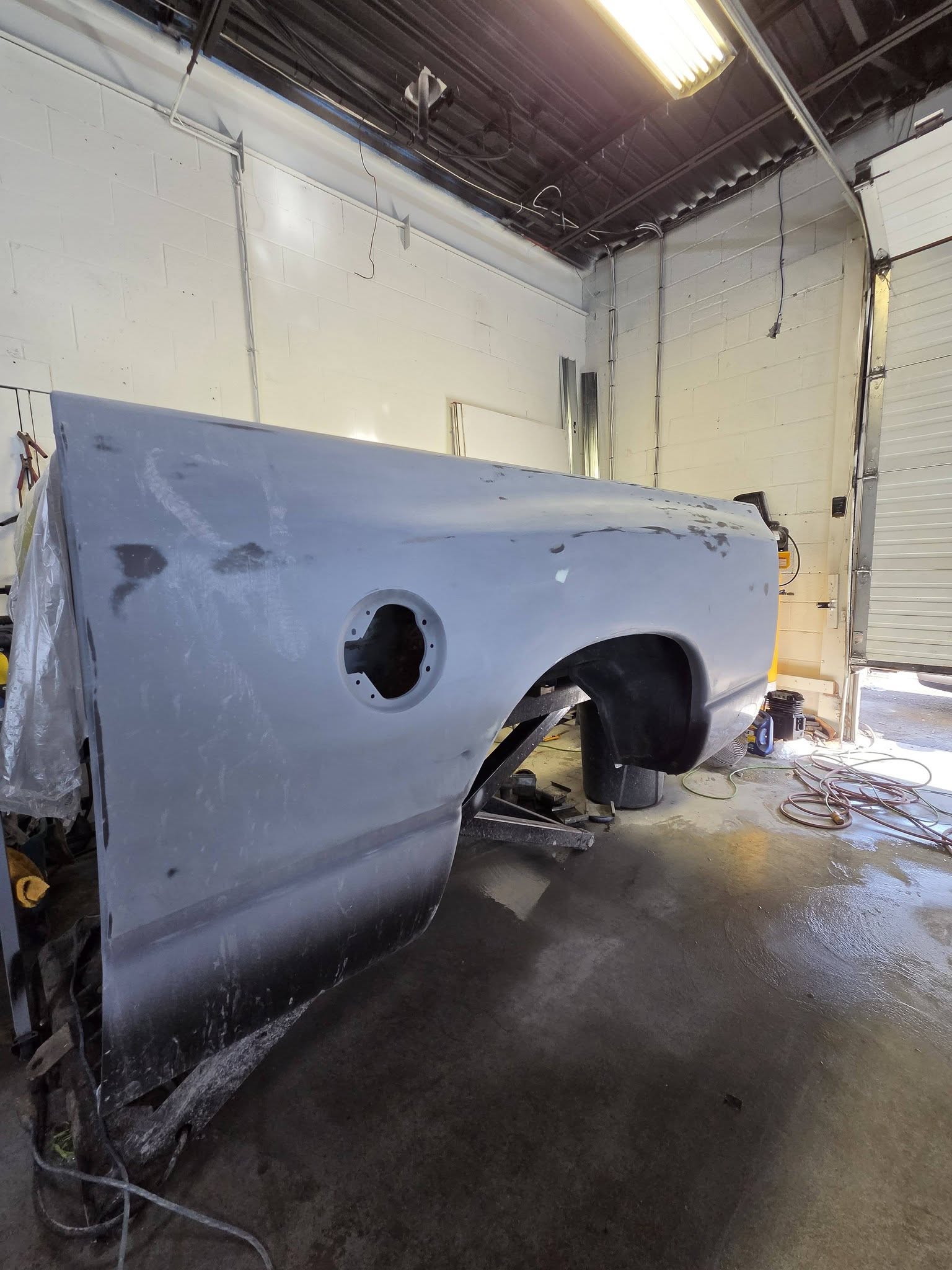
Frame rail repair in Markham — structural, not cosmetic.
The frame rail is the backbone of your truck or body-on-frame vehicle. It carries crash-load paths, suspension mounts, and towing loads. When it rusts, we don't patch over it — we cut it out, fabricate a matching boxed section, and weld it in to restore full structural integrity.
Why it matters
Frame rails carry the vehicle's entire load path
On a body-on-frame truck or SUV, the frame rails are what everything else bolts, hangs, or welds to — the cab, the bed, the suspension, the engine mounts, the towing hitch. On a unibody car, the structural subframes and rail sections play the same role, tying the crumple zones and suspension pickup points together. When that steel rusts through, it isn't a cosmetic problem — it's a loss of structural capacity exactly where the vehicle needs it most.
Frame rails are boxed sections, meaning the steel that's actually rusting is often on the inside of a closed channel. Road salt and moisture get trapped inside through drain holes, seams, and crossmember mounting points, and corrosion eats the rail from the inside out. By the time rust is visible on the outer wall, the inner wall may already be significantly thinner — or perforated entirely.
A weakened rail can sag, twist, or flex under load in ways it was never designed to. That shows up as body misalignment, doors that stop closing properly, a truck bed that no longer lines up with the cab, or — in serious cases — a frame that can buckle under towing or lifting loads. This is why frame rail repair has to be treated as a structural job, not a bodywork job.
Common frame rail problems on Ontario vehicles
- Rust perforation at crossmember mounting points, where moisture pools against the bracket
- Corrosion behind leaf spring hangers and shackle mounts on trucks
- Rail sagging or misalignment from years of internal wall thinning
- Rust starting inside the boxed section, invisible until it perforates the outer wall
- Weakened frame around body mounts, causing cab or bed shift
- Surface pitting and scale on the rail's outer face from years of road salt exposure
- Cracking at factory seam welds where rust has undermined the joint
- Frame rust that's been painted or undercoated over without being cut back to solid steel
Our process, step by step
- 01
Hoist inspection and load-path assessment
We put the vehicle on a hoist and inspect the full length of the rail, including crossmember mounts, spring hangers, and body mount points, to map exactly how far the corrosion has spread.
- 02
Sound the boxed section for hidden corrosion
Because rust often starts inside the closed channel, we test wall thickness and check for soft spots to find damage that isn't visible from the outside before we commit to a repair plan.
- 03
Cut out the corroded section
Once the extent of the damage is confirmed, we remove the affected section cleanly back to solid, unaffected steel — no shortcuts, no welding over compromised metal.
- 04
Fabricate and weld in a matching boxed section
We fabricate a replacement section to the manufacturer's rail geometry and gauge, adding reinforcement plates at mounting points where appropriate, then weld it in with full penetration seams.
- 05
Measure, align, and seal
The repaired rail is measured against factory reference points to confirm proper alignment, then sealed and coated to keep moisture from starting the process over again.
When to repair — and when it's too late
Surface pitting and scale on the outer face of the rail are cosmetic-only in the early stages, but they still need to be treated and sealed before moisture works its way to bare steel. Localized through-rust — a perforated section around one crossmember mount or a short run of the rail — is usually a strong candidate for cutting out and sectioning with fabricated steel. That's the majority of frame repairs we see, and it restores the vehicle to full structural capacity when done correctly.
We'll tell you plainly when that's not the case. If corrosion has spread along multiple mounting points, undermined more than a short section of the rail, or compromised the frame near a major structural junction, the fabrication, welding, and alignment work required can exceed what the vehicle is worth — and in some cases the safety risk of a repair that can't be fully verified outweighs the benefit. Every quote includes an honest assessment of whether repair is the right call, not just whether it's possible.
What determines the cost
- How much of the rail's length and how many boxed sections are affected
- Whether the corrosion is limited to the outer wall or has perforated through
- Proximity to crossmembers, spring hangers, or body mount points requiring reinforcement
- Steel gauge and rail geometry required to match the manufacturer's specification
- Access — whether the bed, cab, or suspension components need to come off first
- Alignment verification required after sectioning to confirm the frame is true
Frequently asked
- How do I know if my frame rails are rusted?
- Frame rails are boxed — rust often starts on the inside surface where road salt and trapped moisture sit, so it can perforate the outer wall before it's visible from underneath. Warning signs include reddish-brown flaking near welds, soft spots you can push a screwdriver through, uneven ride height, or a truck that feels loose or shifts under towing load. Any suspicion of frame rust warrants a hoist inspection.
- Can a rusted frame rail be repaired, or does the vehicle need to be scrapped?
- It depends on how far the corrosion has spread and where. Localized rust in a boxed section can usually be cut out and replaced with a fabricated, welded-in section that matches the factory geometry. But if rot has spread along multiple crossmember mounts, spring hangers, or has compromised more than a short run of the rail, the repair cost and safety risk usually outweigh the vehicle's value.
- Will a repaired frame rail pass Ontario safety inspection?
- Yes, when it's done correctly. Ontario's Motor Vehicle Inspection Standards treat the frame as a critical structural component — any sectioning has to restore the rail's strength and geometry, not just cover the hole. Our welded repairs are built to those standards and can be verified by any licensed inspector before you're back on the road.
- Is it safe to tow or lift a vehicle with frame rust before it's repaired?
- Not without an inspection first. Frame rails carry the load paths for towing, suspension, and jacking. Rust-weakened steel can deform or fail suddenly under load. If you suspect frame corrosion, have it checked before hooking up a trailer or putting the vehicle on a hoist by its frame.